Choosing the right solar system is one of the most important decisions when investing in solar energy. Every property has different electricity requirements, budgets, and power availability, which means there is no single solution that fits everyone. Understanding the differences between On-Grid, Off-Grid, and Hybrid Solar Systems helps homeowners and businesses select the most suitable option.
At Shaheen Sun, we provide complete solar solutions, including consultation, system design, installation, maintenance, and after-sales support. Whether you are planning a residential rooftop solar system or a large commercial installation, our experts help you choose the system that delivers the best performance and long-term savings.
This guide explains how each solar system works, along with its benefits, limitations, and ideal applications.
Understanding the Three Types of Solar Systems
Solar systems are generally divided into three categories:
- On-Grid Solar System
- Off-Grid Solar System
- Hybrid Solar System
Each system is designed to meet different energy requirements and usage patterns.
1. On-Grid Solar System
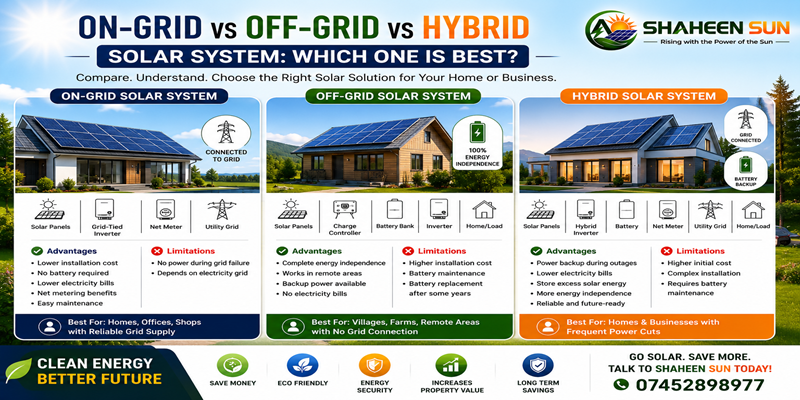
An On-Grid Solar System, also called a Grid-Tied Solar System, is directly connected to the electricity grid. It generates electricity during the day, and any excess energy can be exported to the grid through net metering, depending on applicable regulations.
How It Works
- Solar panels generate electricity.
- The inverter converts DC power into AC power.
- Your home or business uses the generated electricity first.
- Excess electricity is sent to the utility grid.
- Additional electricity is imported from the grid when solar generation is insufficient.
Advantages
- Lower electricity bills
- No need for battery storage
- Lower installation cost
- High system efficiency
- Net metering benefits (where available)
- Low maintenance requirements
Limitations
- Does not provide backup power during grid outages unless paired with additional backup solutions.
Best For
- Urban homes
- Commercial buildings
- Offices
- Schools
- Apartments
- Areas with reliable electricity supply
2. Off-Grid Solar System
An Off-Grid Solar System operates independently without relying on the electricity grid. It stores solar energy in batteries for use during the night or on cloudy days.
How It Works
- Solar panels generate electricity.
- A charge controller regulates charging.
- Batteries store excess energy.
- An inverter supplies electricity to the property.
Advantages
- Complete energy independence
- Ideal for remote locations
- Reliable backup during power outages
- No dependency on utility companies
Limitations
- Higher installation cost
- Battery replacement over time
- More maintenance than on-grid systems
- Requires proper battery sizing
Best For
- Farms
- Villages
- Remote homes
- Mountain regions
- Areas without grid access
3. Hybrid Solar System
A Hybrid Solar System combines the advantages of both On-Grid and Off-Grid systems. It connects to the utility grid while also using battery storage for backup power.
How It Works
- Solar panels generate electricity.
- The inverter powers your home or business.
- Batteries store unused electricity.
- Excess power may be exported to the grid where applicable.
- During power failures, the batteries supply backup electricity.
Advantages
- Continuous power supply
- Battery backup during outages
- Reduced electricity bills
- Better energy management
- Higher energy independence
- Future-ready solution
Limitations
- Higher initial investment
- Battery maintenance
- More complex installation
Best For
- Homes with frequent power cuts
- Hospitals
- Offices
- Shops
- Businesses requiring uninterrupted power
Comparison Table
| Feature | On-Grid | Off-Grid | Hybrid |
|---|---|---|---|
| Grid Connection | Yes | No | Yes |
| Battery Required | No | Yes | Yes |
| Backup During Power Cut | No | Yes | Yes |
| Installation Cost | Low | High | Medium to High |
| Maintenance | Low | Medium | Medium |
| Electricity Bill Savings | Excellent | Complete Independence | Excellent |
| Suitable for Cities | Yes | Limited | Yes |
| Suitable for Remote Areas | No | Yes | Yes |